
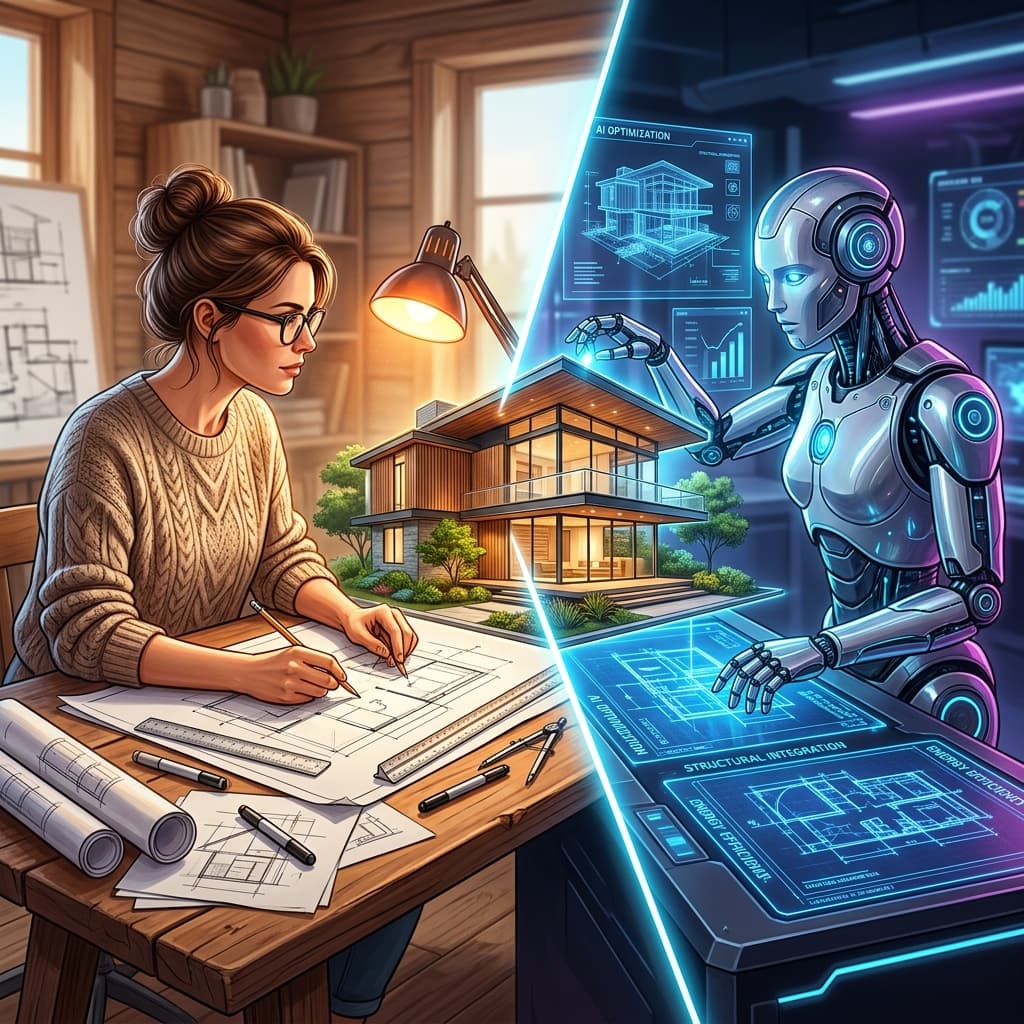
Partners, Not Rivals
Every time a new AI architecture tool launches, the same question arises: "Will AI replace architects?" The answer is a definitive no — but AI will fundamentally change what architects spend their time on. The future is collaboration, and understanding this partnership helps both professionals and homeowners.
What AI Does Better Than Humans
Speed: AI generates floor plan options in seconds vs. days for manual drafting. Optimization: AI can evaluate millions of spatial permutations to find the mathematically optimal room arrangement. Consistency: AI never has an off day — every plan meets minimum quality standards. Accessibility: AI makes professional-quality floor plans available to anyone, regardless of budget.
What Humans Do Better Than AI
Emotional Design: A human architect understands that the client's grandmother needs a room near the prayer area, or that the family gathers in the kitchen rather than the living room. Site-Specific Creativity: Only a human can visit your plot, feel the breeze direction, notice the neighbor's ugly wall that needs screening, and see the beautiful tree that should be framed by the living room window. Aesthetic Vision: AI can optimize, but it doesn't have "taste" — that subjective sense of beauty that makes a home feel special.
The Ideal Workflow
The most effective approach combines both: Use AI for the first draft — generate multiple floor plan options quickly. Use a human architect for refinement — select the best AI-generated option and have an architect customize it with personal touches, aesthetic decisions, and site-specific adaptations. This hybrid approach saves 60-70% of the architect's time while producing a better final result than either could achieve alone.
The Homeowner's Advantage
For homeowners, AI tools like Naksha AI are a superpower. You can walk into your first architect meeting with 5 AI-generated floor plans instead of a vague wishlist. This gives the architect clear direction, reduces back-and-forth iterations, and ultimately saves you money on design fees.
Conclusion
AI and human architects are complementary forces. AI handles the mathematical and generative heavy lifting; humans bring creativity, empathy, and site-specific wisdom. Together, they create homes that are both optimized and inspired.