
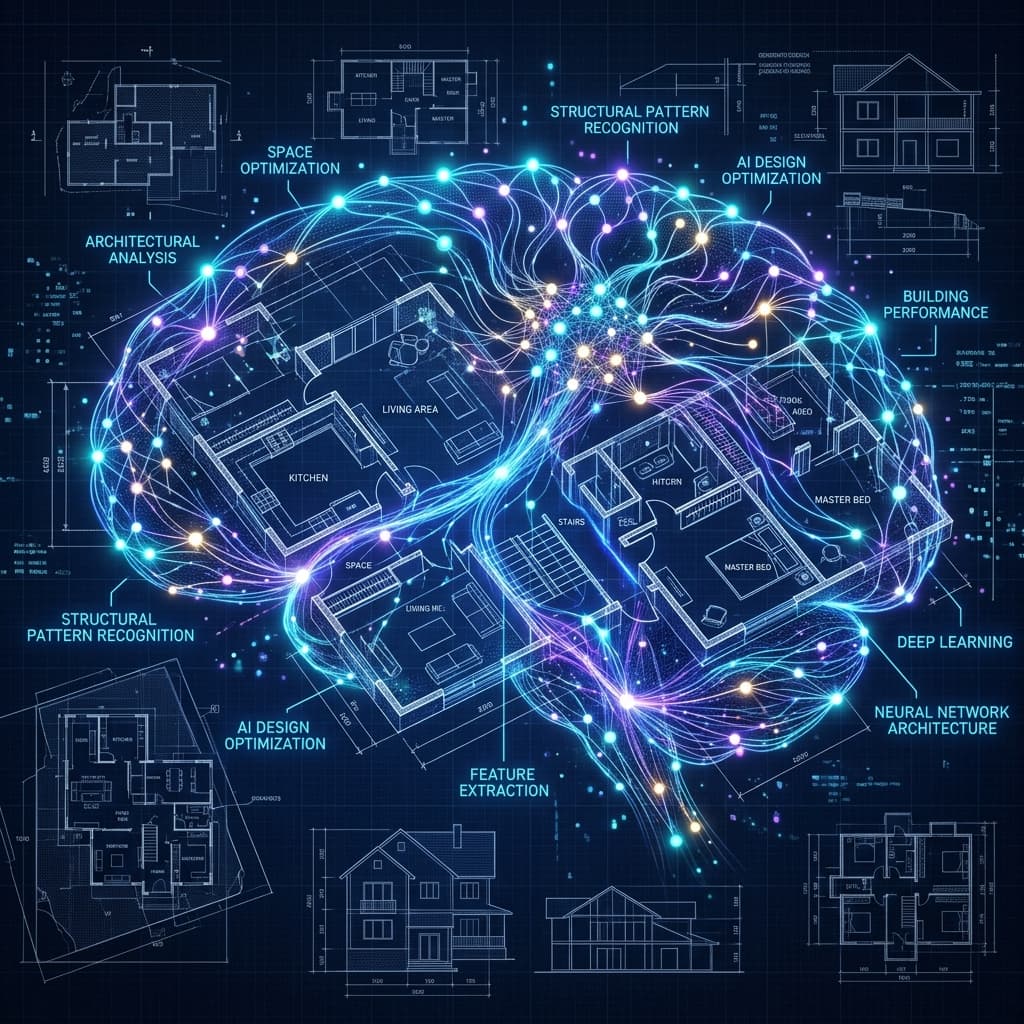
Teaching Computers to Think Like Architects
Machine learning is the branch of AI that learns from data rather than being explicitly programmed. In architecture, this means training neural networks on thousands of successful residential blueprints — plans that were built, lived in, and loved by their residents. The result is an AI that has internalized the invisible rules of good home design.
What the AI Learns from Data
When a neural network analyzes 10,000 floor plans, it discovers patterns that even experienced architects might not articulate: the optimal ratio of private to public space in Indian homes (typically 60:40), the maximum comfortable walking distance from a bedroom to its bathroom (under 5 meters), the ideal kitchen-to-dining distance for efficient meal service, and the minimum living room width that feels "open" rather than "cramped" (12 feet).
Spatial Relationship Understanding
The most impressive capability of ML in architecture is spatial relationship understanding. The AI knows, from training data, that kitchens should be adjacent to dining areas, that children's bedrooms should be near the master bedroom (not across the house), that guest bathrooms should be accessible from the living room without passing through private areas, and that utility areas should be near the kitchen for plumbing efficiency.
Climate and Regional Adaptation
ML models trained on region-specific data understand climatic design principles. For hot-dry climates (Rajasthan, Gujarat), the AI favors thick walls, small windows, and internal courtyards. For hot-humid climates (Kerala, Goa), it prioritizes large windows, cross-ventilation, and raised foundations. For composite climates (Delhi, UP), it balances both approaches.
Continuous Improvement
Unlike a static design tool, ML-based systems improve over time. As more homeowners use platforms like Naksha AI and provide feedback on their generated plans, the model learns what works and what doesn't in real-world Indian homes. This feedback loop makes the AI progressively smarter with every plan it generates.
Conclusion
Machine learning brings the collective wisdom of thousands of architectural projects to every new design. It's like having a team of experienced architects contributing to your floor plan — but faster, cheaper, and available 24/7.